





1. The Biggest Concerns To Our Wealth
Rules-based Investing: An Introduction
Experience is the best teacher. This is especially true with the investment world, which has constantly evolved and innovated to bring new investment strategies and products with time. We all have been pretty familiar with the active style of investing. But now, with the markets deepening, evolving and maturing, we are seeing increasing interest in new investment strategies of passive and rules-based investing. These are interesting concepts of which we feel that investors should be aware.
Introduction to Active & Passive Management:
This is a very common strategy where professional investors or fund management teams take investment decisions on every single security (stocks, bonds, etc.) to either buy, hold or sell from the portfolio. These decisions are in line with the portfolio theme and investment objectives. This style of portfolio management is most commonly seen in mutual funds and PMS. Here, the fund managers have the discretion or freedom to buy/sell any security. The security selection, the proportion/share of the security and the timing of entry/exit are all determined by the fund management team and there is active use of research, information, fundamental & technical analysis, risk assessment, etc for making these decisions.
Active management is aimed at generating ‘alpha’ returns, or higher returns than the benchmark of the scheme/portfolio. The fund managers generally engage in buying and selling securities on a fairly regular basis. Active management thus comes at a higher cost to investors due to higher fund management and transaction costs.
Passive management is almost the opposite of active management. Here, investors have a choice of either investing directly in an Exchange Traded Fund (ETF) or going with an index fund offered by mutual funds. This is a laid back approach to investing where the role of the fund manager is limited to track a given index like BSE Sensex or Nifty 50. The idea is to replicate and mimic the returns of an index, as opposed to outperforming the index. The chosen index dictates the choice and proportion of the stock/security.
Here, there is no discretion or liberty on choice and proportion of securities, which generally remain unchanged for longer periods as compared to active investing. This style of investing thus has the benefit of lower costs.
Active or Passive - which is better? There is no easy answer to this question. Both styles of investing have their pros and cons, and both have their relevance and importance in the Indian markets. The markets currently are dominated by active investment style and passive investing is at a nascent stage but growing slowly.
While passive investing is relatively new and the results of long-term investment success are yet to be understood and evidenced fully in India, in developed markets like the US, it is widely accepted and is popular. Active investing on the other hand does hold the promise of higher returns, but at a higher cost, and the challenge of outperforming the benchmark is not easy. In markets like India, active management still makes sense where there are widespread opportunities for superior stock/security selection to generate alpha.
Let us now ask a simple question? Isn’t there any investment strategy that takes the best of both, active & passive investing?
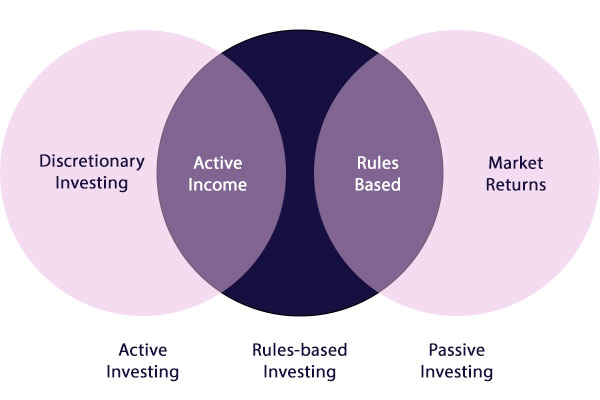
The best of both worlds Rules-based investing is a strategy that takes the best of both worlds, active and passive investing. Rules-based investing, as the graph depicts, aims to deliver active returns (alpha over the benchmark) in a cost-efficient way by following smart investment/portfolio rules.
The core and success of this strategy lies in building rules - rules which are derived based on multiple, time tested factors. These factors can be market and economic indicators like valuations, long term sovereign bonds yields, interest rates, liquidity, etc at the macro level and factors like market momentum, volatility, security indicators like value and quality and so on at the micro/security level. Using the history of how these factors play out, smart models of investment strategy are formed to identify opportunities between asset classes and securities.
These rules guide the fund managers on asset allocation (between equity and debt), security selection, entry and exit decisions and the proportion of the security in the portfolio. As can be understood, personal bias is removed and there is a greater discipline in the entire portfolio management process. The building of the rules even requires the expertise of data scientists/statisticians in addition to senior fund managers and with the new age of computing power, it is now easier to identify and build smart rules and benefit from investment opportunities in the real world.
Rules-based investing or factor-based investing or smart beta, with whatever name called, may or may not have variations to the strategy which we just discussed, but the essence remains the same. This may be a new concept in India but, again, has been popular in developed, western countries. Over time, this style of investing is likely to gain popularity in India too. As can be understood, rules-based investing lies in the middle of active and passive investment strategy and aims to deliver the best of both worlds and should be an interesting product to explore for investors here in India in the coming days.
Active, passive or rules-based investing, your choice of the investment decision should be driven by your own investment objective and risk assessment. It is difficult to say which particular style or approach is the best, and perhaps the verdict will never be out soon. As investors, though, we should be educated on the choices we have and appreciate the nuances of the different styles of investing. The measure of success for us should be if we managed to achieve our own, personal investment objectives and life’s goals, irrespective of product selection or any returns we get. This should be at the back of our mind, whatever we do or choose not to do with our money. Happy investing!
When To Buy And When To Sell?
Types of Return Measures
We all make investments with the common objective of generating the desired returns. Whenever we have to decide on any investment, the return expectation is one critical element that influences our decision. We often compare the performance of multiple investments based on their returns. Note that often returns are expressed or calculated in different forms and have different purposes. We can notice different return measures when we browse through various product literature, brochures, websites, return calculators and so on. Most investors may make mistakes or get confused with the way these returns are measured, used and represented. Therefore, it’s important to understand these types of return measures to draw better, informed conclusions about your investment/portfolio.
Broadly, the returns measured from an investment are calculated by comparing the cost paid to acquire the asset (outflow) to what is earned from it (inflows) and computing the rate of return. The inflows can be from periodic payouts such as interest from fixed income securities and dividends from equity investments and capital gains or losses from a change in the value of the investment. In mutual funds, investors enjoy returns in the form of dividends and capital gains. While the forms of returns may differ, almost every fund or investment’s performance is calculated in the form of standard return measures. Let’s look at some of these types of return measures.
Absolute Returns, as the name indicates, is the absolute growth or decline in your investment, expressed in terms of percentage. The time taken for this change is not accounted for. Generally, this method of calculating returns is used for periods less than 1 year. For instance, the current market value of the investment is Rs. 1,40,000 and the amount originally invested was Rs.1,00,000. In this case, the absolute return would be 40%. People often use absolute returns to measure the returns on real estate, like how many ‘x’ times has your property value grown? Since we are not considering time here, often absolute returns can be very misleading over one year and the longer the period, the more misleading it gets.
As the name suggests, Annualized returns measure how much your investment grew in value ‘annually’ or yearly. The absolute returns of the investment are normalised or spread out over yearly periods and a single ‘return’ is derived. An important thing to note in annualized returns is that the effect of compounding is included. Hence, even if the number may not look very attractive at first, over longer periods, it can greatly impact returns. Investors should be careful in not discounting this power of compounding inherent in the annualised returns.
Let us see with an example - what is better? 15% annualised returns for 5 years or 85% absolute returns? Normally, people think that 15% by 5 times is 75% and hence 85% is a great deal. However, considering the power of compounding, the 15% option gives you a much higher effective return of 101.14%. This difference in returns can grow to astonishing numbers over longer periods.
The total return is the actual rate of return earned from the investment, considering all forms of inflows and appreciation. For mutual funds /stocks, it would include both capital gains and dividends. Total returns are important to consider when there are different forms of return/income from a given investment to realise its true value.
For instance, you invested Rs 1,00,000 at NAV of Rs. 20 and you purchase 5,000 units (Investment/NAV) of a scheme. After a year the NAV of your scheme grows to Rs.22 hence the value of your units grows to Rs. 1,10,000. Here, capital gains made by you are Rs.10,000. Now in the very same year, your scheme declares a dividend of Rs.2 per unit, hence the total dividend received by you is Rs.10,000 (units by dividend). If we sum up all the returns we get a total return earned by you of Rs. 20,000 which makes your total return 20%.
As the name suggests, the point-to-point returns measure annualized returns between two points in time. To calculate point-to-point returns of a mutual fund scheme, you necessarily need to have a start date and end date. Often, we see that returns are expressed in terms of fixed periods of say 1 year, 5 years, 10 years and so on. Here the ‘To Date’ is always the present or the date of the report /calculation and the ‘From Date’ is the period before the ‘To Date’. Investors should understand that the choice of ‘To Date’ makes all the difference to returns, and may or may be truly reflective of the quality/performance of the investment.
CAGR is the most common mutual fund return used when a fund’s performance, usually seen for longer holding periods. While Annualised returns is generally used to convert less than one-year returns to an annual return, CAGR is used for longer periods to give compounded annual returns. CAGR considers the start and end value of the investment and the period concerned while normalising all highs & lows of the investment during the period. One important point to note is that CAGR does not consider periodic investments or multiple cashflows. Thus, if there are multiple investments in a year at irregular dates, CAGR may not provide a good picture. It works best on a point-to-point basis where we are considering one-time investments.
What if we have multiple cashflows - inflows and outflows, say in the case of SIP? Which measure to use if CAGR is not suitable? The Answer is XIRR.
The Internal Rate of Return (IRR) is a very common measure used to calculate the returns from a series of cash-flows. XIRR, as the name suggests, is the extended version of IRR, used to calculate returns on investments where multiple cashflows are happening at different times. In XIRR, the CAGR of each cash flow is calculated, and then they are considered together to give you the overall CAGR.
When we talk about mutual funds in India, we have clear guidelines on what has to be disclosed w.r.t. scheme returns. Importantly, regulations do not allow anyone to promise any returns unless it is an assured returns scheme. Regulations require the scheme performance to be compared and shown against the scheme’s benchmark. The returns are required to be calculated based on ‘Total Returns’ Index values and when the scheme age is +3 years, point-to-point returns and CAGR as on a particular date, both are required to be disclosed. This can be seen in scheme related documents.
Well, after knowing these measures, there are a few things to be kept in consideration. When evaluating any investment or even mutual funds performance, one must not be misled by a return figure in isolation. One must always compare apples to apples, the period, the measure and the product categories being compared should match. A good understanding of how to evaluate returns can assist in evaluating and making investment decisions. However, as it is widely known, past returns are only indicative in nature and may or may not sustain in the future. In any investment decision, returns are just a small part of it. Other factors like risk, liquidity, investment horizon, taxation and more importantly personal factors like risk appetite, investment objective and requirement, etc are more critical to evaluate. An understanding of all these factors, not just returns, is important to succeed as an investor.
NJ E-wealth
Travel Insurance: A Must Before You Step Out
Health insurance has become indispensable today. While buying the same is easy for the young generation, the same cannot be said for senior citizens. No one likes to see their parents get old and fight age-related health challenges. Health costs have become very expensive today, especially for senior citizens, and having to face a financial crisis, in addition to the same, is highly undesirable but not avoidable. This is a problem that needs immediate attention from us.
Universally, people over the age of 60 years are considered senior citizens. This is the generation that, till recently, were at the top of their personal professional careers, jobs or business, and were main contributors to society. Having led a full life of hard work, the generation deserves to live their full age with dignity and without financial hassles. However, with age, the biggest challenge and difficulty they face today is with their health, followed by financial security, for a majority of us. At this sensitive phase of life, depending on children/family for health expenses is something of a worry to senior citizens. It is also likely that things normally don’t get priority, adequate attention and special care in the initial stages of any health issue, leading to further worsening of the case. In short, health care for senior citizens is one subject that needs very urgent attention and also a solution.
Health care needs for senior citizens is pretty common today, and almost every family goes through this phase sooner or later. As people age, the list and likelihood of ailments increases and there is a high risk of even repeated hospital visits/treatments. In most cases, group or floater health insurance policies are found to be inadequate. Buying an independent, adequate senior citizen health cover makes perfect sense and is the best thing to do in order to safeguard your health care expenses in the coming years. This may just protect you from falling into any financial crisis like situation and more importantly, ensure continued availability of proper care and treatment. If you have your parents or any senior citizen in your family dependent on you, taking health insurance cover should be considered as your duty and responsibility towards them while being smart about your own finances. If you are a senior citizen, a proper cover might just save you from burning your life’s savings.
As the name suggests, most insurers offer senior citizen health insurance policies to people in the age group of 60 years and above. Like any other insurance product, health insurance for senior citizens is a simple contract between the insurer and the policyholder who pays a premium to the insurer and in return, the insurer pays for the medical expenses. Usually, the scope of coverage covers hospitalisation, day-care treatments, post and pre-hospitalisation, of the insured person. However, the premium amount for a senior citizen policy is understandably much higher than health policies meant for a younger individual, since the probability for claims is also very high. Premium though should not be your only deciding factor and one should buy a policy after due consideration of important features and your requirements.
No pre-policy medical checkup is preferred. However, in some cases, the underwriter may request a few medical tests. If you can go for medical tests, this should not be a deal-breaker.
This is a fairly common feature offered by insurers that covers treatment procedures that require hospitalisation for less than 24-hours. These include chemotherapy, radiation, dialysis, cataract, lithotripsy, tonsillectomy and so on. You can prefer policies that offer the maximum coverage, especially for the likely, common and expensive day-care treatments.
Sub-limits are the monetary caps or extra limits put on different heads/nature of expenses under a policy, usually in the form of a fixed amount or percentage of the sum assured. Sub-limits are normally put on expenses like room rent, consultation fees, ambulance charges, and few planned medical procedures. Sub-limits are an important element of a policy that helps protect the liability of the insurer and thus also make the policy cheaper. You may choose a policy as per your needs & budget, although a policy without or liberal sub-limits is preferred.
As the name suggests, these are expenses incurred by the insured before and after hospitalisation. This usually covers medication costs, tests, consultation fees, etc. While this is a common feature, the number of days covered is important here and one should prefer one with a higher number of days covered.
This feature covers expenses arising out of treatment at home and is preferred. This is fairly common among the older population, and having this feature can be of great help when required.
This feature helps provide coverage to the policyholder up to a specified limit for the organ donor expenses. This typically covers the in-patient hospitalization and surgery-related expenses for the patient. Having this cover is preferred.
This is a cover for modern therapies and advanced technologies that hold great promise in health treatments. Again, a preferred feature to have.
AYUSH stands for alternative medical therapies/sciences of Ayurveda, Yoga, Unani, Siddha and Homeopathy. This feature covers any of these treatments and is a desirable feature to have.
Most policies stipulate a waiting period for pre-existing and specific diseases, before which the claims may not be admissible. Shorter waiting periods would be more preferred.
his is the percentage of the claim amount that is borne by an insured person, under a health insurance policy and the rest of the amount will be paid by the insurer. Generally, copayment helps in reducing the premium amount. A few insurers are also giving an option to reduce Co-Pay thereby reducing out-of-pocket expenses. Such a feature is more preferable.
This is the extra sum-assured added for every claim-free year as a reward for not claiming on his health insurance. Again, a common feature and a good thing to have in your policy.
This benefit restores your sum insured after it has been exhausted along with the accrued Cumulative Bonus, within a policy period due to an accident or any illness or hospitalisation. So, even if you consume the entire sum insured, you need not worry as if you have this benefit your insurance company can restore the entire amount and you can use it in the future. This is a good feature to have in a policy.
Old age requires more prevention and protection in terms of health, and medical check-ups can help you to achieve that. There are few policies that are offering free annual health check-ups, which again is a good feature to have.
OPD stands for “Out-Patient Department” where patients visit for diagnosis and tests without being admitted to the hospital. An OPD is an important cover that ensures that you will be covered by your health insurance even without hospitalisation and where even smaller costs are covered as well. And in this age, the probability of frequent consultation is higher due to seasonal diseases. With this cover, you are eligible to make multiple claims of consultation throughout the year until the limit is exhausted.
Health policies for senior citizens is a must and should be considered on priority. While the premiums may seem expensive to some, they should be seen as an investment and not an expense. Understanding your needs and buying the right policy is crucial. If required, you can seek help from your insurance advisor. As discussed, an adequate health cover can prove to be very fruitful in future and give you peace of mind.
loans
LAS Term Loan is the loan available to clients against their investments. It provides liquidity without having to liquidate investments, at times when funds are required in an urgency. The securities like Equity/Debt mutual funds, shares are pledged. At a very competitive rate, a loan is provided against the pledged securities.
Below client can apply for LAS Term Loan:
Tax Status Mode of LAS term Loan application
Resident Individual Online (E-wealth Account)
Below clients are not eligible to apply for LAS Term Loan:
  1. NRI (both NRE & NRO)
  2. Minor (as minor's securities can not be pledged)
  3. PMS (Portfolio Management System) client
  4. Non Individual clients – Partnership Firms, HUF, Company, etc.
Clients can get the loan on Equity funds, Debt funds, Arbitrage funds, Liquid funds, Shares (BSE 500). Please find below details for the same.
Particulars Max LTV
Equity Mutual Fund Type 25% - 50%
Debt Mutual Fund Type 50% - 80%
1. Loan against Perpetual bonds, Closed ended funds and ELSS in lock in period is not offered.
2. LAS Term Loan is not offered on PMS investment.
Fund Manager INTERVIEW
Partner Image
Mr. Chockalingam Narayanan Head of Equities - BNP Paribas Asset Management India Pvt. Ltd.
Mr. Chockalingam has over 14 years of experience. He is a Post Graduate Diploma in Management from T. A. Pai Management Institute, Manipal. Prior to joining BNP Paribas Mutual Fund, he has worked with Deutsche Equities India Pvt. Ltd. and at Batlivala & Karani Securities.
Read More
NJ E-wealth

Kotak Deepak Amrutlal (ARN-127784)
AMFI REGISTERED MUTUAL FUND DISTRIBUTOR

Deepak A Kotak

  • Retirement Assessment
  • Child Future Assessment
  • Portfolio Review
  • Mutual Fund:Debt / Equity / ELSS

"We have taken due care and caution in compilation of this E Newsletter.Certain products and services offered may not be traded on exchange. All disputes with respect to the distribution activity, would not have access to the Exchange Investor Redressal Forum or Arbitration mechanism. The information has been obtained from various reliable sources. However, it does not guarantee the accuracy, adequacy or completeness of any information and is not responsible for any errors or omissions of the results obtained from the use of such information.In accordance with the applicable laws, we are permitted to only render incidental advice with respect to mutual fund products only to its mutual fund distribution client. For every other purpose, including distribution of non-mutual fund products, this material is for informational purposes only. Investors should seek proper financial advice regarding the appropriateness of investing in any of the schemes stated, discussed or recommended in this newsletter and should realise that the statements regarding future prospects may or may not realise. Mutual fund investments are subject to market risks, read all scheme related documents carefully. Past performance is for indicative purposes only and is not necessarily a guide to the future performance."

This Page is Best Viewed with Chrome Browsers

"In investing, what is comfortable is rarely profitable."

For better investment contact