


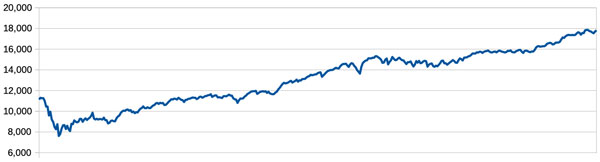






Answer : The Covid situation definitely has improved but it is not fully behind us. Good news is that in most parts of the world, vaccination seems to have brought some impact in lowering hospitalization and fatality rates. On that front, in India, we have now vaccinated over 50 crs individuals with 1 or more doses and look poised to finish both doses of vaccination by the end of the year for the adults (source: Union Health Ministry). Obviously, for children, some tests and trials are on before end-use authorization is allowed. This improvement in situation has definitely encouraged more states to reopen economies in a phase-wise manner and that is starting to have an impact on the overall recovery. Government finances seem to be healthy with tax collections in the current year stacking much better than previous years – even if we exclude the RBI dividend. So in that sense, there seems to be reasonable fiscal firepower that is available for use. While central banks could start to withdraw liquidity and also possibly raise rates at some point, the baton seems to be moving to the fiscal policy side and there we seem to be reasonably having the room to do so.
Answer : The market is reasonably awash with liquidity and retail participation has been at the highest levels. That historically has led to good IPO markets. The good part is - this will make the market more representative of the economy. A lot of the sectors that were playing a large part in the economy were not represented – be it e-commerce, fintechs. So from that perspective, this will be good.
However, investors need to tread with caution. Alongside some of these marquee business listings, we are also seeing a whole host of other companies that have proximate peers already listed. Now given this frenzy, we are actually seeing a lot of premiums (in terms of multiples) and money chasing these new unknown names for public markets when actually more credible similar companies with track records being available at much cheaper levels. That dichotomy will at some point in time get bridged.
The sector(s) mentioned in this document do not constitute any recommendation of the same and BNP Paribas Mutual Fund may or may not have any future position in these sector(s).
However, investors need to tread with caution. Alongside some of these marquee business listings, we are also seeing a whole host of other companies that have proximate peers already listed. Now given this frenzy, we are actually seeing a lot of premiums (in terms of multiples) and money chasing these new unknown names for public markets when actually more credible similar companies with track records being available at much cheaper levels. That dichotomy will at some point in time get bridged.
The sector(s) mentioned in this document do not constitute any recommendation of the same and BNP Paribas Mutual Fund may or may not have any future position in these sector(s).
Answer : The results season has been a mixed one. Given the very benign base from which one is looking at, the growth numbers are looking fairly buoyant. If we look through from a two year CAGR basis, even then growth is clearly visible. Revenue expectations have been largely met but margins have been a tad below expectations given the steep inflationary pressure that is running across. Profit after tax (PAT) also consequently seems to be a tad below expectations. The overall earnings per share (EPS) estimates of the street (as per Bloomberg) for the benchmarks like Nifty/Sensex to that extent have been largely plateauing vs an increasing trend seen in the last two quarters.
The good part is that leading businesses across most sectors seem to have taken the pain upfront and hence barring a very bad subsequent wave(s) of Covid-19, we seem to be reasonably well positioned. So from the earnings perspective, we believe we are reasonably positioned for a mid-teens earnings growth in the next 24 months.
The good part is that leading businesses across most sectors seem to have taken the pain upfront and hence barring a very bad subsequent wave(s) of Covid-19, we seem to be reasonably well positioned. So from the earnings perspective, we believe we are reasonably positioned for a mid-teens earnings growth in the next 24 months.
Answer : Among asset classes, Equity is the longest duration asset class and tends to attract the highest risk capital. This is also reflected in the manner one gets access to cashflows of a firm – ideally equity holders get paid the last after all stakeholders, i.e., vendors, Government, Employees, lenders, society, etc. So any volatility to any of the other stream of cashflows for other stakeholders, equity holders get impacted the most – both ways. In that sense, there is a lot more behavioral aspect at play as well to investing in equity markets. While there are leads and lags in the way it moves, from a long term point of view, the market movements broadly mirror the cash generation to the equity holders or the promise of that over a period of time in future. So in this construct, valuations today are running at an elevated level with trailing twelve month price-earnings ratio (PE) now at around 26x. Hence, the risk-reward balance is tilted more towards risk. That said, the earnings delivery (and cashflow generation) has been pretty sharp over the last three quarters which coupled with easy liquidity is holding up the markets. If either of these legs start to falter, we could see some correction.
However, at our end, we focus on following our time tested BMV (Business, Management, Valuation) investment philosophy and this has held us well in the long run.
However, at our end, we focus on following our time tested BMV (Business, Management, Valuation) investment philosophy and this has held us well in the long run.
Answer : Following an investment philosophy with discipline is important for any investor. At our end, we follow the BMV (Business, Management, Valuation) philosophy that focusses on businesses that grow at a rate better than the economy and industry a company operates in, that have a sustainable MOAT; the businesses being run by competent management with good execution track record, capital allocation, and corporate governance. If a company filters through all these, then we focus on Valuations, and that too not just headline numbers but cashflow-driven valuations.
Answer : Starting to invest early in life and also in oneself are good points to start with. Like for our health we consult doctors, and teachers for education and lawyers for legal issues, it is good to consult a financial advisor for one's financial needs. Like health, financial investing is also very personal – the horizon to invest, the goals one is working towards, the age from which you start off, etc. is very different for each individual and hence that needs to vary as per their needs. Have the right asset allocation, and do a periodic reset with discipline. These go a long way towards generating returns in the long run.