
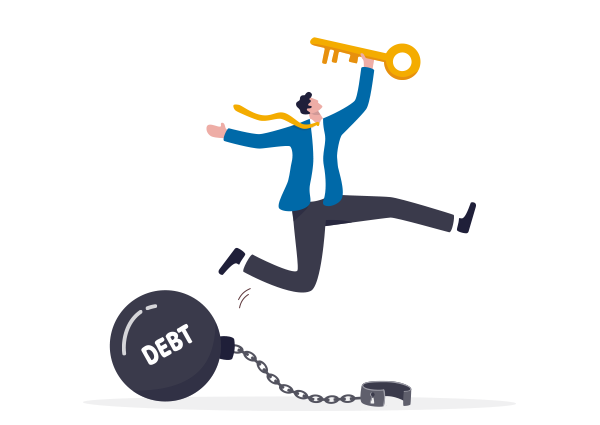




BECOMING DEBT-FREE: ONE-STEP AT A TIME
In the millennial economy of buy now & pay later, to be debt-free is quite a task. While everyone likes the idea of being debt-free, most of us don't even know what it truly means. Being debt-free doesn't mean you should have absolutely zero or nil debt, it's more like maintaining a minimal amount of good debt and eliminating all the bad debts that might impact your financial well-being.
Draw up a list of all the incomes & expenses you need to consider or take care of while managing debt. Start by working out fixed costs like rent, school fees, utility bills, household necessities etc. After this, list out all the variable/avoidable expenses like going out, online shopping, entertainment expenses, etc. Also, list down all your existing debts in detail. Include things like the purpose of the loan, pending loan amount, EMI amount, due dates & interest charged. Lastly, detail all your existing investments & savings. This list will give you an overall picture of your debt situation.
Now that you have the list prepared, it's time to prioritize your debts and cut back on expenses. As mentioned before, not all debts are bad. Debt taken to create an asset is considered good and benefits you in the long run. Whereas, if you are piling up debt for sheer luxury or any non-beneficial purpose, then it's best to pay it off as quickly as possible. Even the interest charged on such debts is enormous compared to standard loans. Set a priority for all your existing debts and accordingly check if your monthly cashflows are comfortable enough or not. Ideally, you should also be left with at least 10% of your income to save. If not, you need to cut back on your expenses.
When managing your debt, it is always better to never miss a payment as it reflects very badly on your credit score. Try and have an auto-pay system for your liabilities, including your credit card bills and make sure that you have sufficient balance /cash stashed in your account at the start of the month for this amount at the bare minimum. Always aim to pay off your credit card balance before the due date and avoid rolling over the balance to the next billing cycle to ignore excessive interest and additional debt burden.
The next thing you need is a solid repayment strategy to pay off debts as quickly as possible. You can use one or more repayment techniques to get out of debt. Generally, you have two options: 'Pay More Than Minimum' or 'Debt Snowball.' You can pay more than the minimum amount required each month to lower your debt if you have excess savings. If you pay more than the minimum, you will be minimizing the amount of interest charged each pay cycle. Start from the smallest amount, as it's the easiest one to repay. Make sure the lists of your debts are handy. Keep updating them as you start prepaying debts.
Another option is to use the snowball strategy which involves paying off your smaller debts first, and then moving on to larger ones. This allows you to prioritize your repayment list based on the amount owed, starting from small. This strategy will assist you in gradually eliminating your debt. You might also use the cascading method, which involves paying off the credit card bills or loans with the highest interest rate first rather than the lowest. When compared to snowballing, this is a faster and less expensive strategy.
A hands-on approach can help you successfully pay off debt if you sincerely follow the process. If you have a strong repayment history, you may also contact the issuer and ask if they can renegotiate your loan and the terms of repayment, especially if you are facing some genuine concerns. If you've been a good customer, most lenders will work with you to find a solution.
In short, it is easier to avail debt, but it is a lot tougher to make it zero. People fall into a debt spiral, looking for the easy way out, which often results in a debt trap or financial stress. It's best to avoid any debt as far as possible for lifestyle purposes at any point in life, especially so when you are young. Instead, try to save as much as you can and be flexible to take risks in life. If you are in debt in the initial years of your life, you will spend a majority of your learning and wealth creation period paying EMIs. Even good debt, like buying a house, has to be planned properly. Consider it when you are settled in life, are sure about your career and preferably, have your spouse by your side. It should not happen that by the time you become debt-free, you realize that the majority of your work-life is already over, and in a few years, you will be retiring. This realization at a later stage of life is painful for many people. Therefore, do your best to remain debt-free through sound financial investments, savings, and proper planning.
NJ E-wealth
CREDIT MISTAKES YOU SHOULD AVOID
Credit! This term in India has quite an image in the financial world. A lot has progressed over the years in terms of credit. From the entire process to various products, there has been quite a shift. Before taking credit was not considered a good thing, it used to reflect a financial imbalance. However, these days, it may have become unavoidable. But have you ever wondered, how is your creditworthiness judged? How do financial institutions decide if credit should at all be given to you or not?
Credit cards have this very convenient feature that lets you pay only the minimum amount of expense on the bill due date. Now easy as it sounds, not paying the due amount is as good as a late or missed payment because you are charged a high-interest rate on the unpaid amount till you pay it off, leading to a debt pile you don't want. So, avoid believing the myths like paying the minimum credit amount is enough & keeping the due balance on your credit card improves your credit. In reality, they hurt your credit score and cost you money. You will have a higher credit utilization rate & lower credibility. Therefore, only spend the money you can afford to pay back on time & clear the entire due amount.
Many think that missing a few payments /EMIs on a loan /credit is not a big deal. However, missed payments or late payments can have a huge bearing. Whenever you miss a payment, interest is often chargeable on your unpaid balances. Also, the interest is levied daily and increases day by day, leading to snowballing. Additionally, it leaves a permanent negative entry on your credit report and lowers your credit score.
One of the common ignorance of most of us is that we do not review our credit card statements and instead, blindly pay the entire amount. We miss paying attention to possible instances of fraud or errors. Sometimes the fraud or error amount is so small that people do not realize it until they arise repeatedly. We recommend reviewing all your loan and credit card statements carefully and regularly in order to avoid any possibility of error or fraud. Additionally, you will also have better clarity of your spending, the loan /credit transactions and the applicable interest rates and other costs.
Each application has the potential to knock points off your credit score. Every time you apply for any sort of credit or even a credit card, the issuer will fetch your credit report from the credit bureau. Such report requests are hard enquires, and they reflect in your credit report. Therefore, if you make multiple applications with different entities in a short period, you appear to be a credit-hungry person, and lenders may start getting suspicious about your objectives. Such actions may even bring your credit score down a few notches. Research well before making any such sort of application and zero in on limited institutions.
Taking out cash withdrawal is the costliest thing you can do with your credit card. It may seem convenient, but it comes at a hefty price. Every time you withdraw cash through your credit card, a high cash advance fee of 2.5%-3.5% applies to the withdrawn amount. In addition, finance charges are also charged right from the day of withdrawal till the date of repayment. Therefore, always keep this option as your last resort and use it in an unavoidable emergency.
The credit utilization ratio is the proportion of the total credit limit utilized by you from your credit card. Not handling this ratio or keeping it high, raises concerns to the credit bureau that can hurt your credibility. Usually, credit utilization over 30-40% is cautious, and experts suggest keeping this ratio under 30%. If you cannot maintain this ratio, try to maintain at least 20% of your total credit limit free, and do not ever max out your credit, as this can lower your credit score.
A charge-off is the most harmful thing which can happen to your credit score. When your credit gets charged off, it states that your account has gone into default, and if it stays unpaid for more than six months, the lender may sell it to a collection agency to recover the debt. The charge-off remains on your credit report for seven years and can significantly impact your future financial dealings. So, if you have a delinquent account, get it active before it hurts your credit score.
To have more than one credit card is not a bad idea as long as you use your credit cards wisely and responsibly. Keeping multiple well-maintained credit accounts open for a lengthy period helps your credit score as the average length of time you had credit is one factor that helps decide your credit score. If you close a credit card, especially your oldest card, you lower the average length of your credit history, which will increase your credit utilization ratio and ultimately reduce your credit score.
To summarise, having loans or using credit cards is not necessarily bad. However, it all depends on how best you manage your dealings keeping in mind that this will be recorded and referred to by every financial institution in future. Having good credit behaviour can go a long way in not negatively affecting your credit scores and hurting your pockets. By avoiding these common myths & mistakes, you will be able to take advantage of the benefits of having credit & credit cards.
NJ E-wealth
Sampoorna Suraksha - At The Heart Of Your Financial Planning
Life has become uncertain in the current environment. The past few years have made us see the uncertainty surrounding our life and health, in addition to many other challenges. This would have come as a surprise for many but now this is the well-accepted reality of life. Our financial planning is incomplete unless we provide protection against these uncertainties of life.
Simply put, insurance is an arrangement by which an insurance company undertakes to provide a guarantee of compensation for a covered risk /loss in return for a premium. The basic purpose of insurance would be not to profit but to ensure that you are financially compensated for any loss, damage or uncertain event. The idea is to protect your financial well-being and your life savings.
The four main risks in life which could be a real possibility for any one of us, are stated below as the "4 Ds".
  • Death
  • Disease
  • Disability
  • Disaster
In this, article, we will look at how we can protect ourselves against all these 4 Ds through a combination of insurance products.
Life insurance should be seen as an investment for the future of your family as it protects your family against any financial crisis in case of an unfortunate event. The idea is that your family's future is not compromised and all of their needs are taken care of. In the absence of adequate life insurance cover, the entire future of your dear ones is at risk. While the importance of life insurance is known to everyone, unfortunately, the average life insurance coverage for Indians is very low. The life insurance cover must be adequate for covering the following:
  • All outstanding liabilities & future loan repayments
  • Life goals for children like education and marriage
  • Household expenses for foreseeable future
  • Family health care & insurance premium needs
  • Emergency funds
A life insurance policy offers coverage against natural or accidental death. You may additionally opt for critical illness or accidental disability through riders. There are also policies that cover a child's future.
Health issues, illness and hospitalisation can hit any person at any time. Health insurance is equal to wealth insurance. Health issues are an undeniable, unavoidable event which is very likely to happen once every few years in every family, either with self, children or parents. It becomes very important to have adequate health insurance covering all family members in the family. Another important fact is that medical inflation is much higher than regular inflation and is in double digits.
There are a lot of choices available with health insurance like individual plans, family floater plans, senior citizen plans, critical illness plans, disease-specific plans, group insurance plans, etc which can be bought as per your need. The scope for comprehensive coverage under health insurance policies would be
  • Hospitalisation expenses
  • Pre- & post-hospitalisation expenses
  • Day care treatments
  • Expenses like ambulance, ICU, cost of medicines, tests, etc.
Personal accident insurance is another critical element of financial protection for your loved ones. This specifically covers risks related to any mishap originating due to an accident. A personal accident policy is also very affordable and one should ideally take as higher an amount as possible. A personal accident policy specifically covers risks related to accidents resulting in-
  • Accidental death
  • Accidental hospitalisation expenses
  • Permanent total disability
  • Temporary total disability
  • Temporary disability with loss of income
Given today's lifestyle and habits, there are many critical illnesses that have become very common and affecting people even at a very young age. Estimates show that one in every four men and one in every five women are affected by critical illness before they reach the age of retirement. Illnesses like strokes, cancer, kidney failures, heart valve surgery, coma, etc can drain you mentally, physically and even financially. A single illness /disease can potentially ruin your entire life savings. Often, your regular health insurance plans prove to be inadequate, given the high costs of treatment of such illnesses. A critical illness cover can save the day at a very low, affordable cost.
A happy home is a dream of many. Your home is your most precious asset. Unfortunately, rarely do we think of protecting the same, along with the prized possessions, and contents therein. We can easily do this with the help of a comprehensive householders package policy which comes at a surprisingly affordable cost. There are risks faced like burglary, fire, riots, natural calamities, smoke, etc. which can potentially destroy your life's savings. Such a comprehensive policy will offer coverage against a covered loss /risk for
  • Dwelling /building structure like walls, ceilings, flooring, etc
  • Personal property coverage, covering furniture, electronics, clothing, etc
  • Liability coverage for guests for any injury or damage to property, if found liable
  • Other structures not attached to your home like a shed, garage, fence /boundary walls, etc.
Ideally one should aim for 'Sampoorna Suraksha' or complete protection of your family's financial future and not leave anything to chance. Such complete protection will mean having a life, health, personal accident, critical illness and home insurance policies with "adequate" coverage. If you are having car or motor insurance that may be added to the list but perhaps you would already have the same since it is mandated by law. A comprehensive basket covering all these risks may seem to be a little too much to some but it is something which is very practical and necessary. You may talk with your insurance advisor /expert to know how you may protect yourself from all the 4Ds with the right selection of suitable policies as per your needs. So let's start planning for sampoorna suraksha for sampoorna shanti (peace) against the fears & uncertainties of life.
loans
Ans. LAS Term Loan is the loan available to clients against their investments. It provides liquidity without having to liquidate investments, at times when funds are required in an urgency. The securities like Equity/Debt mutual funds, shares are pledged. At a very competitive rate, a loan is provided against the pledged securities.
Ans. Below client can apply for LAS Term Loan:
Tax Status Resident Individual
Mode of LAS term Loan
application
Online (E-wealth Account)

Below clients are not eligible to apply for LAS Term Loan:

  1. NRI (both NRE & NRO)
  2. Minor (as minor's securities can not be pledged)
  3. PMS (Portfolio Management System) client
  4. Non Individual clients – Partnership Firms, HUF, Company, etc.
Ans. Clients can get the loan on Equity funds, Debt funds, Arbitrage funds, Liquid funds, Shares (BSE 500). Please find below details for the same.
Particulars Equity Mutual Fund Type Debit Mutual Fund Type Arbitrage Funds
Max LTV 25% - 45% 60% - 85% 50%

Note:

  1. Loan against Perpetual bonds, Closed ended funds and ELSS in lock in period is not offered.
  2. LAS Term Loan is not offered on PMS investment.
Fund Manager INTERVIEW
patner Interview
Mr. Vinit Sambre
Head - Equities, DSP Mutual Fund
Vinit Sambre is Head - Equities at DSP Investment Managers. He has been managing the DSP Micro Cap Fund since June 2010 and is also the Fund Manager for the DSP Small and Mid Cap Fund. Vinit specializes in the small and mid-cap space and has over 20 years of relevant work experience.
Read More

Kotak Deepak Amrutlal (ARN-127784)
AMFI REGISTERED MUTUAL FUND DISTRIBUTOR

Deepak A Kotak

  • Retirement Assessment
  • Child Future Assessment
  • Portfolio Review
  • Mutual Fund:Debt / Equity / ELSS

"We have taken due care and caution in compilation of this E Newsletter. The information has been obtained from various reliable sources. However it does not guarantee the accuracy, adequacy or completeness of any information and is not responsible for any errors or omissions of the results obtained from the use of such information. Investors should seek proper financial advise regarding the appropriateness of investing in any of the schemes stated, discussed or recommended in this newsletter and should realise that the statements regarding future prospects may or may not realise. Mutual fund investments are subject to market risks. Please read the offer document carefully before investing. Past performance is for indicative purpose only and is not necessarily a guide to the future performance."

This Page is Best Viewed with Chrome Browsers