





Handling Volatility in Markets
There is Nothing Certain, But the Uncertain.
We are now used to surprises and uncertainties. In the context of the ongoing war, we believe everyone is deeply pained by the tragedy unfolding before us and the loss of human lives. We will try and keep the emotions aside as we speak of the subject today. The truth is, we all are today ready to accept and adapt to a crisis better than ever. This has come at the cost of our personal experience during the pandemic. It has made us stronger. The recent events though have started reflecting on the equity markets and our portfolios. While the volatility of the markets is nothing new, the real question is, how are we reacting to such volatility in markets?
Most investors feel like reacting in response to some sudden market movement, usually a correction /fall. The important thing to note is that there is no need to react in response to an event, even less any reason to panic. No amount of stress or panic or reaction will make things better for you. Worse, it may only lead to wrong decisions.
As of now, we are clear, uncertainty is an essential part of investing. No investor should invest in equities if he/she does not have the stomach to handle volatility and corrections in the portfolio. Old investors would know that there have been multiple occasions and events when markets saw big and small corrections. There will be many more in the coming decades too, especially on the global geopolitical front. These will impact trade and relations between countries and the domestic economy as well. As investors, we should be ready for uncertainty.
At times of uncertainty, it's always better to go back to basics. In case of sharp portfolio changes, whether on the upside or downside, it is always better to check your asset allocation and reallocate resources accordingly. If the equity portion has fallen, then probably you can shift some from debt to equity and vice versa. Your defined asset allocation can also be changed to take advantage of any extreme market levels. Getting back to basics will answer your question - what should I do?
A diversified portfolio with appropriate asset class level diversification between equity and debt is always recommended. Within each asset class, further diversification is also recommended in the kind of schemes you hold. There are large-caps, flex-caps, mid-caps, theme-oriented funds and so on. The right mix is welcome and will insulate your portfolio from specific risks to select types of companies /market segments. Within debt too, there is a lot of scope for diversification.
Almost every time there is a crisis, an opportunity lies somewhere. The idea to make good of an opportunity is purely a non-emotional one and surely no one is hoping for a crisis to occur. But since it does occur and there is nothing we can do about it, making use of the crisis for your benefit is the right thing to do. Almost every big fall is like a discount sale happening on the market where you can add fresh money or move money from debt to equity. Such opportunities are rare and short-lived so it's always better to be proactive and consult your experts before making any decisions.
To be calm and have patience and not do anything in face of a crisis is one of the good virtues of a wise investor. It's always better to not react and do anything which would be repented later. Know that any fall in your portfolio is only temporary and notional in nature and selling will only make it real and permanent. Unless there is a real, unavoidable reason to sell, there is no need to get out. As investors, you can also explore other options of financing like loans against securities or mutual funds that will ensure that no loss is made, and your financial needs are met too.
We strongly believe that a sustained long-term wealth creation journey requires a helping hand. A financial products distributor or an expert is strongly recommended. The primary role of such a person is to handhold clients to navigate through the challenges and mould the financial behaviour. Reach out to your mutual fund agent, expert or advisor to guide you from time to time and during such periods of uncertainty.
NJ E-wealth
GOLD - THE SHINE CONTINUES!
When it comes to making investments, the Covid-19 pandemic has been a game-changer. The accompanying uncertainty compelled people to restructure their financial portfolios to achieve long-term security. With this backdrop, gold emerged as an attractive investment option in recent times.
Gold is seen as a hedge against inflation and also against any political or economic crisis or disruptions. Being a safe asset, gold is seen as an attractive investment option when the markets are under pressure and there is uncertainty. It is important to understand why this is so. Gold is a real asset, it is limited in supply and has cultural value in most societies. With rising prosperity, the demand for gold continues to rise, and this demand keeps the prices higher. Everyone assumes that the price of gold will only rise in the future. On the other hand, when inflation is high, people are fearful of equity markets being expensive and gold performs well during such times. During high inflation, investors also tend to get more attracted to gold as fixed income assets become less attractive to long-term investors. A study by World Gold Council notes that for every 1% rise in inflation, Indian gold demand spikes by 2.6%. Gold offsets inflation as the rise in the price of gold is usually higher than inflation.
The love for gold by Indians is famous as the private gold holdings of Indians is the highest in the world. In 2017, the World Gold Council estimated that Indian households own some 24,000 metric tons of gold. It can be anywhere between $1.5 to $2 trillion at today's price and largely sums up the jewellery that families inherit or are gifted at weddings. However, having physical gold carries a high risk and comes at a great cost. Here are the things we need to be wary of.
The question of purity of gold arises every time one goes out to buy gold from their local jeweller. It was a big problem till the arrival of big brands where you get certified hallmark gold. However, in all the other cases, it only boils down to how much you trust the seller and you can only hope you get what you pay for.
Keeping gold at home is a big worry for most of us. There are risks of theft, loss or damage to the gold. Usually, gold at home is used rarely at events. Keeping it at home thus has risks and safe storage costs.
While making any gold ornament, there is typically some wastage, making and labour charges. Its expressed as a percentage of the gold by traditional jewellers in India. It may vary from around 3% to even over 25%. Some jewellers may break this up and charge separately.
When you sell gold jewellery, the money you receive often tends to be much lower than expected. There is always a difference between the buying price and the selling price at your local jeweller. In addition, you won't be able to recover the making charges when you resell your jewellery. Selling gold is a hassle as you may need to find the right shop to sell. The absence of the original invoices and certificates too can cost you money.
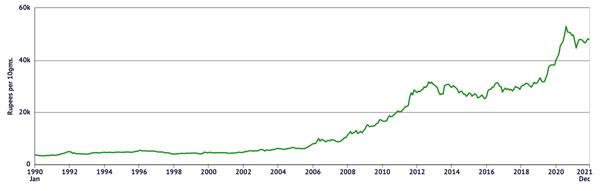
Over the past 10, 20 & 30 years, the returns delivered are around 5.5%, 12.5% and 8.7% respectively. As seen, gold over the past decade has just about managed to beat inflation. Against this, BSE Sensex has delivered around 11.9%, 14.6% and 10.2% for the past 10, 20 and 30 years respectively. Gold has had its period of stagnant, negative and attractive returns and hence, nothing is guaranteed. Further, these prices are just the market prices and independent of the risks, costs and charges associated with physical gold, as discussed above.

Below is the graph showing the historical price trend for 10 gm gold.
NJ E-wealth
All the gold that Indians hold privately is locked up and has no economic value or contribution to the nation. Policymakers in India have long tried to monetise this high holding but have failed. Governments have tried to dissuade people from buying physical gold by imposing duties. The Sovereign Gold Bonds (SGB) is also an attempt by policymakers to divert people to buy gold bonds instead of physical gold. SGBs is like a digital alternative to physical gold issued by the Government of India. The SGBs also eliminate several risks and costs associated with physical gold that we discussed above.

The government has further made SGBS attractive for individual investors. Here are the key features of the same.
  • With SGBs, investors can earn interest every year of 2.5%.
  • There is no capital gains tax for individuals if held till maturity. The indexation benefits are available for long term capital gains on the transfer of the bond.
  • While the tenure of SGBs is of eight years, there is an option to exit after the fifth year.
  • Investors will get a holding certificate as proof of investment.
  • The investment limit for individuals is between a minimum of 1 gram and a maximum of 4 kgs.
  • The SGBs are tradable on stock exchanges within a fortnight of the issuance on a date.
Gold can be considered as an asset class by investors looking to diversify their portfolios. Other than cultural and emotional reasons where you are keen on buying physical gold, buying digital gold in the form of SGB should be the preferred option. SGB is a better substitute for physical gold when it comes purely to investment purposes. SGBs offer an almost guarantee of realisation of the market price without any cuts. They also offer the convenience of online transacting and tracking, along with the pride of owning gold. Any investment and asset allocation decision should be purely based on your overall financial needs and risk profile.
NJ E-wealth
Global Health Insurance: An introduction
The world has become smaller and travelling abroad is no longer a luxury. Whether you are a travel enthusiast, a business person, an employee or a student, you will most likely spend time outside India. Today, travelling abroad has become a need for many and while you may enjoy visiting and staying at foreign places, your health is a matter of prime importance. There is always some fear in mind like, what will happen if I face any medical emergency outside my country in an unknown place? There have been instances where medical care/treatment is sought outside India. The question is what policy will cover the health insurance needs of a global citizen?
A key element of any health policy, this covers the medical expenses of an insured person, in case of hospitalisation for more than 24 consecutive hours arising from a disease/ illness or injury.
This covers the medical expenses of an insured person in case of Day Care Treatment or Surgery that requires less than 24 hours of hospitalisation.
This covers the medical expenses of an insured person, incurred towards a disease/ illness or injury that occurs during the policy period and immediately before the insured person’s date of hospitalisation for a specified maximum limit of days.
This covers the medical expenses of an insured person, incurred towards a disease/ illness or injury that occurs during the policy period and immediately post-discharge of the insured person from the hospital for a specified maximum limit of days.
Outpatient Department treatment or OPD refers to doctor visits required for medical treatments and diagnosis where hospitalization is not required.
This covers the medical expenses for the treatment, which in the normal course would have been covered for hospitalisation under the Policy, but is taken at home on the advice of attending medical practitioner, under some specific circumstances.
This covers the cost of travelling/transfer to the nearest suitable medical facility for medical treatment in case the policyholder is ill or injured, and the required medical treatment is not available locally within the opted Area of Cover.
This covers the charges incurred towards the repatriation of the insured person from outside India, within the opted Area of Cover, on an emergency basis to his/her residence/hospital in India.
This covers the charges towards the transportation of the mortal remains of the insured person from the place of death, within the opted Area of Cover, to his/her residence in India.
This covers the charges of vaccine(s) incurred towards the insured person which is mandatory/prescribed for visiting a foreign location.
In addition to the above basic covers generally offered by most insurers, there are few optional covers available such as air ambulance cover, domestic/global second opinion cover, hospitalisation cash, concierge services, convalescence benefit, cover for medical devices & non-medical items and so on. One may also choose to get the add-on cover for critical illnesses.
Typically, in any health insurance policy, there are some things explicitly excluded. This basically includes medical conditions arising due to the use/ abuse of a drug or any intoxicating substance and any illness or hospitalisation arising or resulting from any breach of the law.
There is no substitute for a global health insurance policy in case of an emergency in a foreign land. It can be your friend, guide and your financial saviour, ensuring proper and timely treatment and freeing you from all sorts of tensions. Since medical treatment overseas is usually very expensive and financially a huge risk, you need adequate cover that is usually available with global health policies. In addition, global travel health insurance may provide you with additional covers and benefits. Global health policies in the market are normally available in two geographic options, global or global excluding US & Canada.
As can be understood, a policy offering greater coverage and benefits can be a bit costly, but it should be worth it as the need arises. Buying any insurance is a question of your needs & requirements. It is also essential that you know the inclusions and exclusions and opt for the optional covers and add-ons carefully. Consult your insurance advisor for more details.
loans
Ans. The following are the charges applicable on NJ Capital LAS Term and Consumer Loan - These charges are deducted from the loan amount at the time of disbursement.
Sr no. 1 2 3
Particulars Documentation Charges [Fresh Loan] Documentation Charges [Top-up Loan] Processing Fees (applicable on all loans taken)
Amount (Rs.) Rs.500/- + GST Rs.200/- + GST 0.5% of the Sanctioned Loan Amount or
Rs. 20,000/- whichever is lower + GST
For Consumer Loan-
Sr no. 1
Particulars Documentation Charges [For Fresh and Top-up Loan]
Amount (Rs.) Rs.200/- + GST
Note Pledging & Un-Pledging charges are Rs.15 per ISIN + GST.
Ans. No, client must post a query from his E-wealth account for unpledging the securities after Foreclosure /Repayment.

Module path (Login to e-wealth account > Help & Support > Send Query > LAS related > Query subtype - Request for Unpledging of securities)
Fund Manager INTERVIEW
patner Interview
Mr. Vihang Naik
Portfolio Manager – Equity - at L&T Investment Management
Vihang Naik is fund manager at L&T Investment Management with an overall experience of 11 years in equity research. He manages L&T Long Term Advantage Fund, L&T Emerging Opportunities Fund and co-manages L&T Midcap Fund.Prior to this, he was a Research Analyst with MF Global Sify Securities. His previous assignments include research analyst in Motilal Oswal Securities and SBI Cap Limited. Vihang is a Certified Financial Analyst and a Bachelor of Management Studies from Mumbai University.
Read More

Kotak Deepak Amrutlal (ARN-127784)
AMFI REGISTERED MUTUAL FUND DISTRIBUTOR

Deepak A Kotak

  • Retirement Assessment
  • Child Future Assessment
  • Portfolio Review
  • Mutual Fund:Debt / Equity / ELSS

"We have taken due care and caution in compilation of this E Newsletter. The information has been obtained from various reliable sources. However it does not guarantee the accuracy, adequacy or completeness of any information and is not responsible for any errors or omissions of the results obtained from the use of such information. Investors should seek proper financial advise regarding the appropriateness of investing in any of the schemes stated, discussed or recommended in this newsletter and should realise that the statements regarding future prospects may or may not realise. Mutual fund investments are subject to market risks. Please read the offer document carefully before investing. Past performance is for indicative purpose only and is not necessarily a guide to the future performance."

This Page is Best Viewed with Chrome Browsers